Dielectric and Pippin Technical Service quickly diagnose and repair a critical antenna fault, returning two FM stations to full power with minimal disruption
Over-the-air broadcast pioneer Dielectric has completed an infrastructure upgrade for two Canadian media broadcasters with the help of regional integration partner Pippin Technical Service (PTS). Following reports of an antenna failure, Dielectric and PTS’ combined expertise enabled a rapid diagnosis and response, helping restore the radio antenna to full operation.
One of the two companies is a long-standing partner of PTS that operates radio and television broadcast and production facilities across the country. “We work with this company on projects nationwide, both in studios and in RF,” says Tyler Everitt, CEO of Pippin Technical Service. “They’ve been using several Dielectric antennas across their sites for years.”
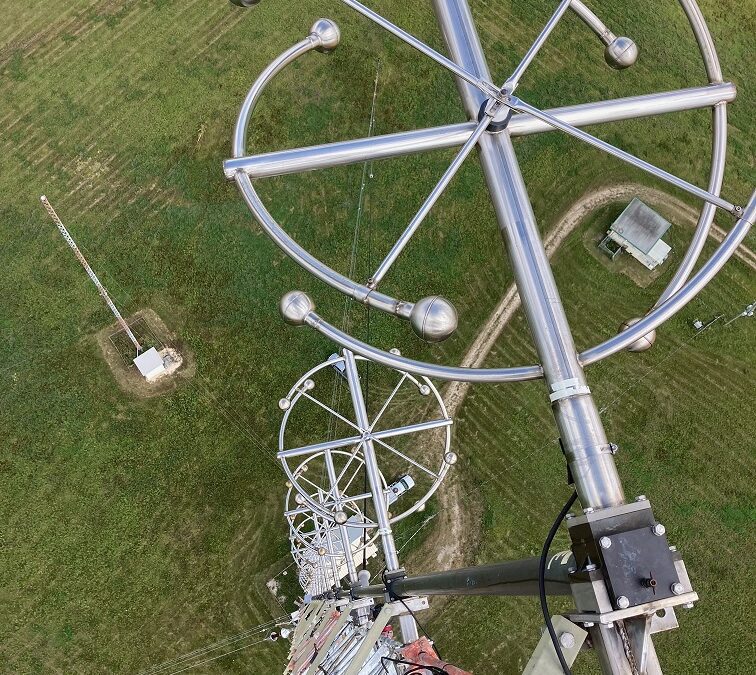
In this instance, a multi-channel, circularly polarized DCR-M antenna in Winnipeg had developed a fault, resulting in disruptions for two FM radio services owned by separate entities but operating on the same system. “The antenna was originally installed over twenty years ago and has provided the station with excellent service. Thanks to Dielectric’s detailed documentation and responsive support, only a few upgraded components were required to address the failure,” says Everitt.
The fault was detected when the antenna began arcing due to a component coming loose, resulting in a surge of reflected power. “When power is reflected back into the transmitter, it can damage numerous components,” said Everitt. “This led to a catastrophic situation where the antenna stopped functioning and briefly took both stations off air.”
A tower crew was deployed to investigate and photograph the suspected areas of concern, which were sent to PTS for examination. All 12 bays were found to be intact, but several of inter-bay junction blocks required replacement. The team also found that the de-icing system has been non-functional for some time, likely contributing to the arcing issues. The PTS team completed a sweep of the system once these areas were identified and the necessary components replaced.
The stations were initially switched to a backup antenna at reduced power, resulting in limited coverage and a weaker signal. “When the signal isn’t as good and it gets scratchy, people will often switch to another channel. Problems like this can quickly escalate.”
“For the most part, they were able to operate on the same DCR-M, which is now more than twenty years old,” says Daniel Bizet, International Sales Manager for Dielectric. “They needed some replacement parts and a new de-icer. With these installed they’re good to go for many more years to come. Supporting partners quickly and effectively in situations like this is a key part of what Dielectric aims to deliver. Its antennas are built to stay out in the field for decades.”
“Bigger picture, we have our own sweep test equipment that we can take on-site and send a small signal into the antenna and measure what comes back,” Everitt explains. “This data is translated into a graphical representation of the antenna’s performance and health. Antennas are designed to propagate the signal on each radio station’s assigned frequency. We conduct sweeps to make sure signals radiate correctly without generating excessive reflected power.”
Reduced power can also affect revenue as selling broadcast time is closely tied to audience reach, the size of the coverage map, and total power output. Maintaining full transmission capability is therefore critical, as reduced coverage figures can negatively impact advertising sales. Another reason why quick response to any field issue is critical.
Every station has its own backup strategy, whether from another antenna on the same tower, a dual-fed antenna, or operating temporarily at reduced power. In this scenario, the stations reduced power while the DCR-M repairs were completed.
In an industry where physics largely remains unchanged and innovation can be limited, Tyler Everitt and the PTS team admire how Dielectric continues to push the boundaries of broadcast technology. “We’ve seen how Dielectric’s products create opportunities to advance efficiency while reducing costs for customers. It’s always exciting to witness the new ways they improve their customers’ experience, and it’s a great thing to be part of,” concludes Everitt.